Thursday, March 3, 2016

Garden Job Priorities


You get a phone call from people you do not know who are in the area and would like to visit your garden.

You were not expecting visitors and the garden is not in the shape you would like it to be before you show it to unknown gardeners. You only have a few hours to make the garden presentable.

What do you consider the most important jobs you first have to tackle since you do not have time to do everything you would ideally want to do?


Wednesday, February 24, 2016

The Best Canadian Rose Breeder

In most regions of Canada, roses used to be humorously referred to as "annual shrubs".  There were a few cold tolerant roses among heirloom varieties (such as 'Stanwell Perpetual'), and especially among the Rugosas, but the vast majority of cultivars, including all hybrid teas, required gardeners to take drastic measures to protect them against the winter cold and these measures only worked sometimes.

Then came Felicitas Svejda (pronounced SWAYda) who was born in Vienna in 1920 and passed away on January 19, 2016. For 33 years, she worked at the Central Experimental Farm in Ottawa where she developed hardy shrubs, especially the "Explorer" series of roses which are now grown in many countries with cold winters.

Henry Kelsey, an Explorer rose

Thursday, February 18, 2016

The Cold Garden Micro-climates


We all know that within an area, growing conditions can vary quite a bit due to micro-climates. However, what is a desirable micro-climate in a temperate area, might not be desirable in a place with cold winters like Canada or much of the northern United States.

What grows best in a protected spot is different in cold and in temperate climates


Thursday, February 11, 2016

Weyerhaeuser Bonsais

While trying to sort a large number of pictures I took in previous years, I came upon photos of a collection of bonsais belonging to the Weyerhaeuser Corporation. That collection was then exhibited at the Weyerhaeuser Company Headquarters, near Tacoma in Washington state. It would appear that now it is to be found (or part of it is to be found) at the University of Arkansas.  It was a magnificent collection. Here are some of the pictures I took.


Saturday, February 6, 2016

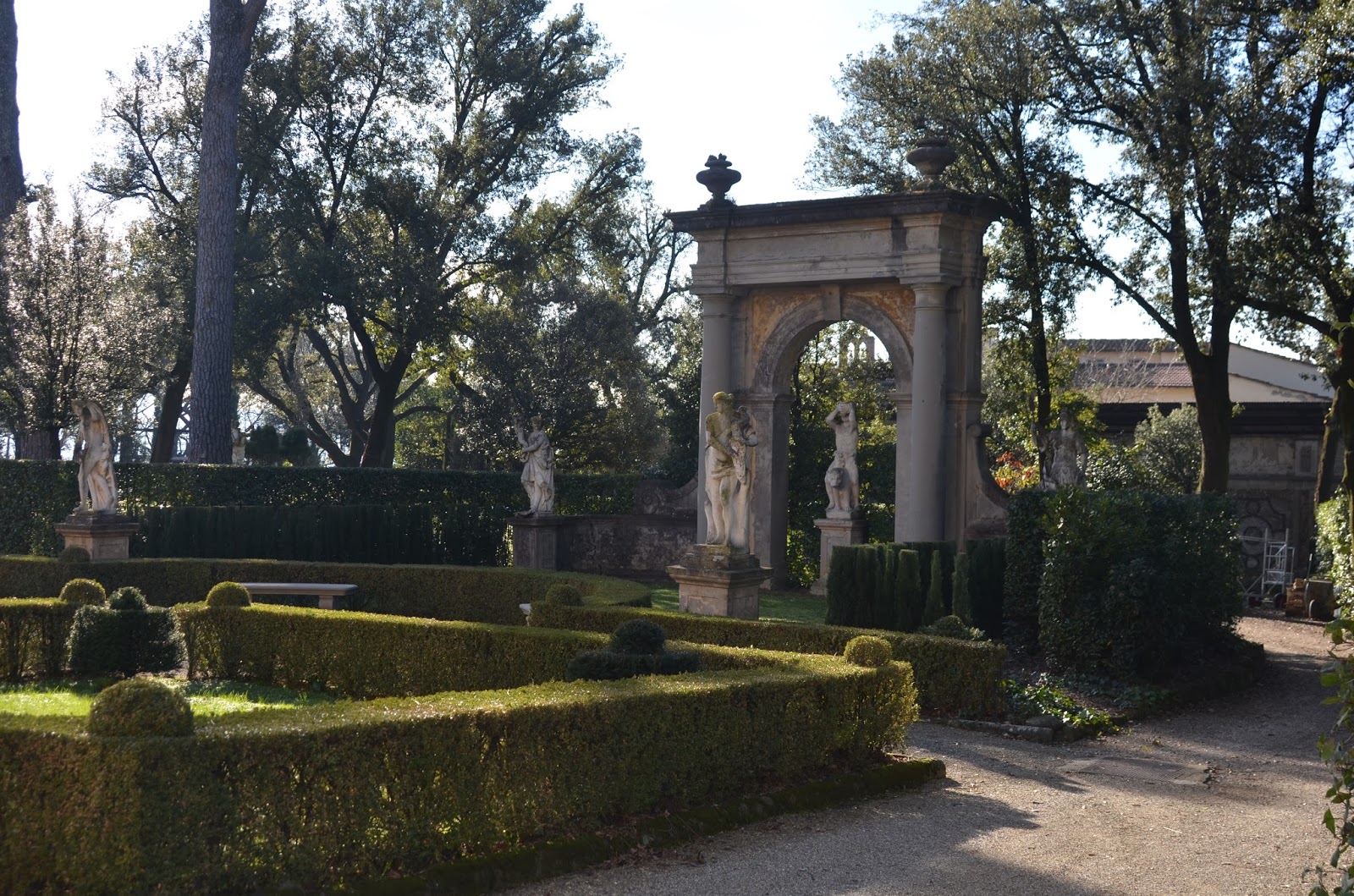
La Pietra

A last Italian garden - Like the garden at the Villa Le Balze, this garden was built by a man who married a woman with a lot of money.

Arthur Acton was a British art collector and dealer who spent much of his life in Italy. His wife, Hortense, was the daughter of William Hamilton Mitchell, founder of the Illinois Trust and Savings Bank.

While the villa was built in the Renaissance, when the Actons bought it in 1907 it only had a park in the English style and a walled vegetable garden.

Arthur and his wife proceeded to create a magnificent Baroque Italian garden, which was preserved by their son Harold, who bequeathed it to the New York University in 1994.


Tuesday, January 26, 2016

Community Gardens in Florence - Orti dipinti

In Canada community gardens are usually what are called allotments in Britain.

The Orti dipinti are actually a series of teaching gardens.

They belong to the community and are staffed by volunteers, but the purpose is not to offer garden plots to the public. It is rather to teach about gardening, especially to school children and the people at an handicapped center next door.


Sunday, January 24, 2016

La Petraia

La Petraia is a 15th century villa associated with the Medici family. You can visit the building which was decorated with 19th century taste when the king of Italy, Vittorio Emanuele II, lived in the villa.

There are two gardens at La Petraia, a green park behind the villa and a formal garden with parterres in front of the villa.


Tuesday, January 19, 2016

Garden of the Vila Le Balze

Tradition has it that the word paradise comes from a Persian word meaning garden. Paradise is indeed what came to my mind when, last week, we visited this garden in Fiesole, outside Florence.

The fact that it was a very sunny, warm day, in the middle of January, might have influenced my judgment!

"Le balze" means the cliffs and the garden is on a sliver of land on a literal cliff overlooking the valley of the Arno and the city of Florence. It does not appear to be well known. None of the books on Tuscan gardens I checked mention it. Perhaps in part because it is difficult to photograph as the garden is narrow and relatively small.

The steep road takes you to this building surrounded by high walls topped by a loggia. All this gives you no hint of the garden.


Friday, January 15, 2016

Giardino Bardini

The Bardini Garden originated in the Renaissance, but it has evolved over the centuries. It only recently opened to the public, in 2005. From the main part of the city of Florence, when you look across the Arno (behind the houses in the photo below), you can see terraces on one of the hills. These terraces are part of the Bardini Garden on the south shore of the Arno.


Tuesday, January 12, 2016

The Archeological Museum Garden

This Florentine garden is not very big, but it is beautiful. I have some merit in getting to see it, since in winter it only opens on Saturday mornings. I went a few Saturdays ago  and was told to come back on the next Saturday morning. The next Saturday I was back, but I was told they did not open that particular week-end. If there were not enough people or the weather did not cooperate, they did  not open!

 Well I was back there last Saturday morning. A different clerk was at the desk. I asked if I could see the garden, and he answered "Of course, I will call the guide".