Sunday, July 12, 2015
Saturday, July 4, 2015
Pink
I thought I would do a few posts on what is in bloom just now, selecting plants by colour. I am starting with pink. Because so far we have had a relatively cool (as well as very wet) summer, many of the things that normally would have finished blooming some time ago (for instance, peonies) are still looking good. Here are a few examples of what is in bloom in pink at Roche Fleurie. Of course, roses make up the majority of the pink blooms.
| John Davis rose |
Wednesday, June 24, 2015
The In & Out Game
This post is not about cats wanting in, then wanting out, then wanting in again, but about plants that leap the garden wall. Because we are in the middle of a wild area where numerous animals might be interested in the garden and especially its plants (deer, hares, skunks - their specialty is digging up looking for grubs - groundhogs, etc...) the garden is all fenced in. There is a strong contrast between the inside, where plants face little competition, and the outside where it is the jungle. Not only are there plants that sneak in from the outside - as is to be expected, weeds will seed themselves in, but, more surprising, are garden plants that move outside the fence to settle, sometimes very successfully among the weeds. I suppose, like William Kent, they "leaped the fence, and saw that all nature was a garden".
| A billion buttercups eager to leap the fence and get into the garden |
Friday, June 19, 2015
Green Shapes
We tend to give more importance to colours than to shape and texture. However, if you reduce colours to a single one - green - shapes and textures become a lot more noticeable as well as more significant and easy to appreciate.
The contrast of shape and texture is more obvious in the early part of the gardening season, before the "actual" colours take center stage, and we start ignoring the backdrop for the garden. In these pictures taken in late spring, the various greens are more distinct and fresh. I try to illustrate the play of shape and texture, without the diversion created by various colours.
Thursday, June 11, 2015
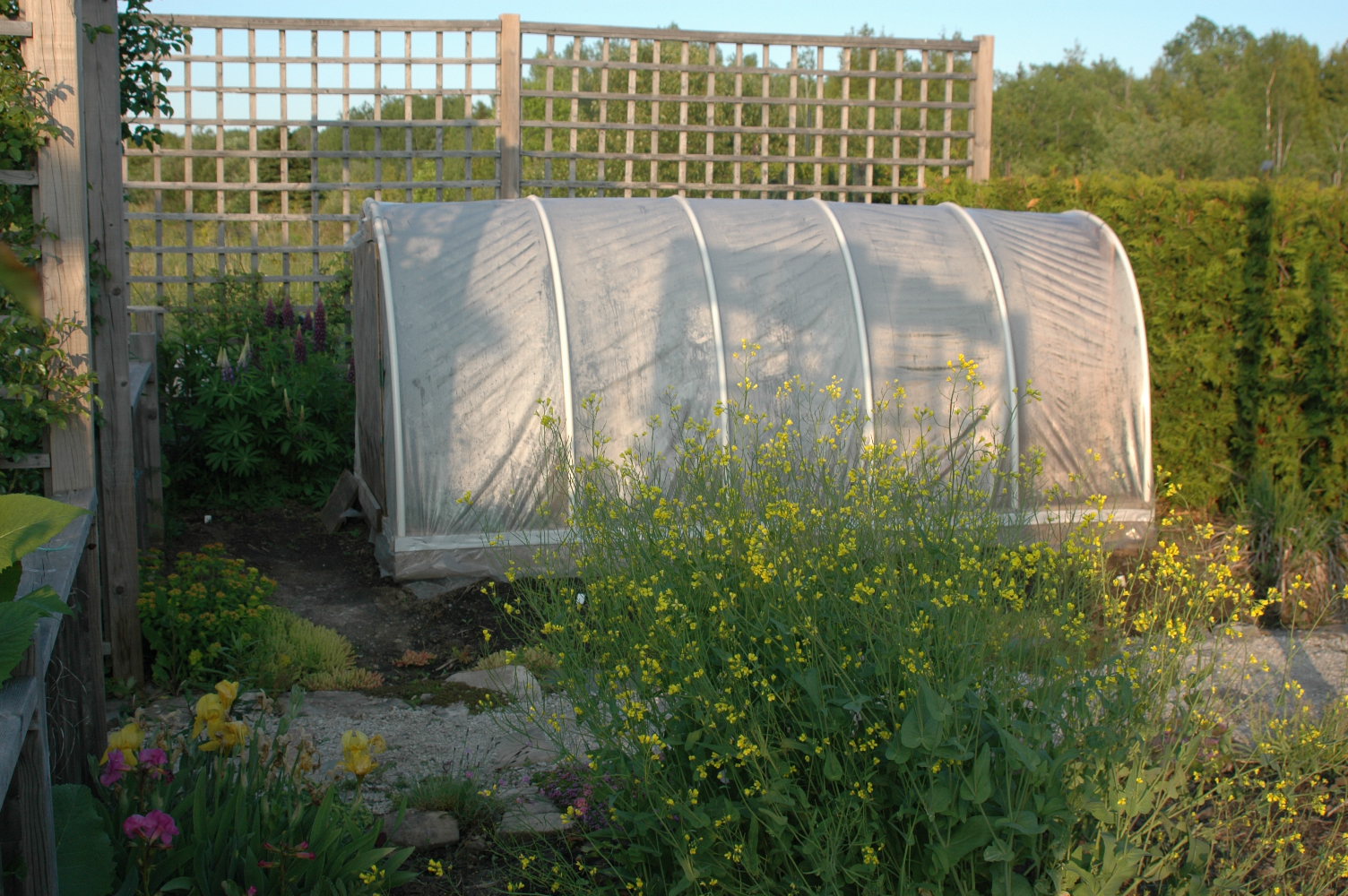
Between a cold frame and a green house
For the
last few years, my friend Tony Barton has tried to come up with a design for
something like a greenhouse or cold frame, in order to extend the gardening season. He
wanted it to be inexpensive and simple to build as well as portable. After experimenting
for a while, he eventually came up with this hoop house which answers all his
requirements.
| Hoop house |
Wednesday, June 3, 2015
Chokecherry blooms as cut flowers
Beth of Plant Posting began her last post with a beautiful photo of chokecherry (Prunus virginiana), one of our very common native shrubs in North America. As Wikipedia says, the natural range of chokecherry is "most of the
continent, except for the far north and far south" so it is not
difficult to find chokecherry outside urban areas. The "cherries" it
produces are edible but, unless quite ripe, are very astringent. They
make your mouth pucker the moment you bite into one. They do make a nice
wine though. I have known this shrub for most of my life, but only this year I have realized how nice the bloom is in flower arrangements.
![]() |
| Chokecherry |
Thursday, May 28, 2015
Unwlecome in the Cold Frame
In our climate, cold frames are useful, but not as much as they are in places with milder climates. If they are in the sun, you cannot leave plants in them in winter, because temperatures in the frames can fluctuate enormously. They stay buried in ice and snow for most of the winter. However they are especially handy in spring.
Sunday, May 24, 2015
Unexpected Invader
We are all familiar with foreign plants that do too well when they are brought to a new continent. It is the case of our native fireweed (Chamerion angustifolium) in the UK, and of the numerous European plants (often medicinal in origin) such as plantain (Plantago major) and coltsfoot (Tussilago farfara) which are completely entrenched in North America.
Sometimes though, a foreign plant will grow or only manage to survive, but it then becomes invasive in some circumstances. It seems to be the case with the cowslip.
![]() |
| Cowslip (Primula veris) |
Friday, May 8, 2015
Friday, April 24, 2015
A Vocal Spring
Version française
Ten days ago we were under snow. Now many of the flowering plants that bloggers from warmer climates have been describing in the last month have rushed into bloom here too. However, if blooms are important markers of the changing seasons, here and at this time of the year, they are not the most obvious.
Subscribe to:
Posts (Atom)